استشاري جراحات المياه البيضاء وتصحيح الابصار وعلاج جفاف العيون
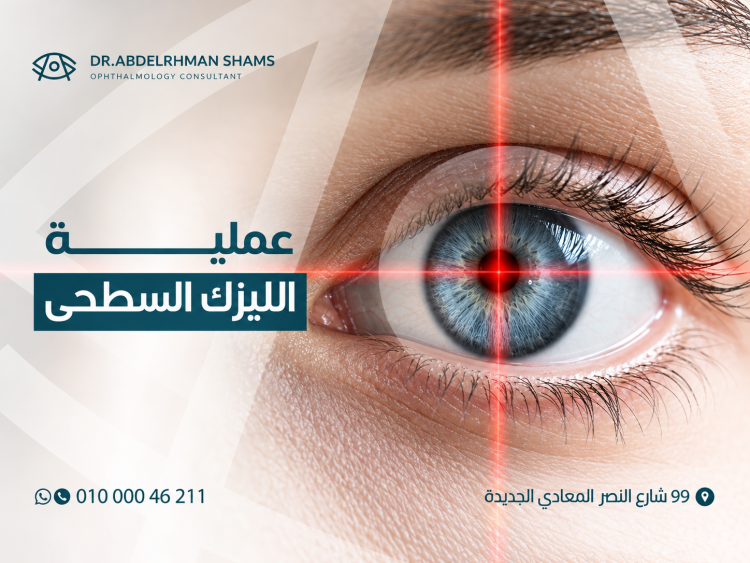
Surface laser incision (PRK) has become one of the latest and most common techniques for treating various vision problems with high precision and safety. The procedure is performed on the outer layer of the eye using excimer laser technology,
allowing the patient to see clearly without the need for eyeglasses or contact lenses.
In this comprehensive guide, we explain what the PRK procedure is, its symptoms, and its most important complications. In addition, Dr. abdelrhman shams (Consultant in Dry Eye Treatment and Vision Correction) will explain the most important tips that the patient should follow after undergoing surface laser surgery to ensure the best results.
What is surface laser treatment (PRK)?
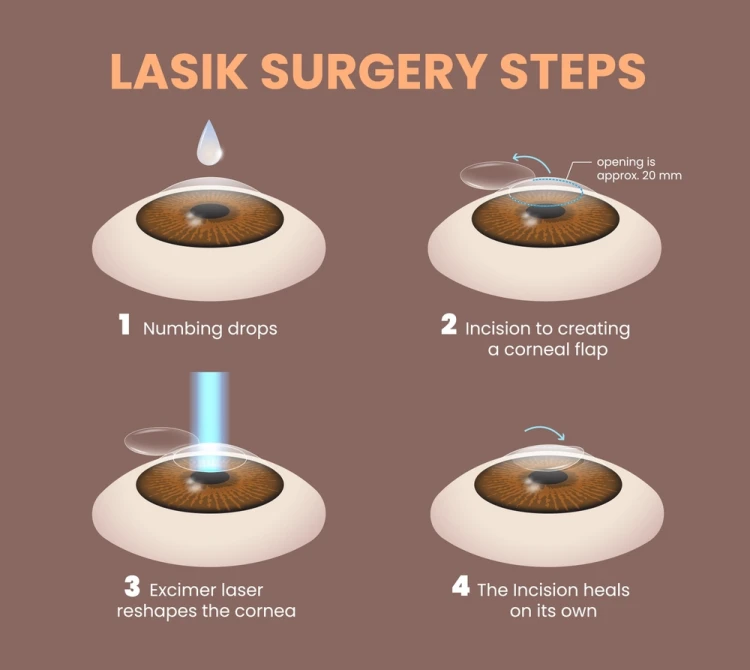
Surface LASIK is considered one of the safest procedures, as the doctor does not cut any deep part of the cornea or remove a flap to correct vision. Instead, the procedure relies on reshaping the cornea and adjusting its curvature to correct vision. The doctor removes only the epithelial layer lining the surface of the cornea, then covers the eye with a therapeutic contact lens for two to three days to allow the corneal surface to heal and return to its normal state.
In this context, the global medical website WebMD indicates that surface LASIK (PRK) is an ideal and very safe option, especially for people with thin corneas or those who participate in contact sports that preclude traditional LASIK. Reports published on the site confirm that not cutting a deep layer of the cornea significantly reduces the risk of long-term complications in the eye tissue, making it a globally recognized and trusted medical technique.
Conditions for performing surface LASIK (PRK) surgery
- The patient must be at least 18 years old.
- The patient's visual acuity ranges from 1 diopter to 12 diopters.
- The patient must have stable vision for one year before the operation.
- The cornea must be thin and not allow for traditional LASIK Eye Surgery Egypt Price (which is determined precisely by the doctor through topographic examination).

Causes of dry eyes after surface laser surgery
Dry eye after PRK (presbyopic Keratomileusis) is common and quite normal. It primarily results from the effect of the delicate nerves in the cornea that control tear production during the procedure, thus reducing the sensation of tears. This is in addition to changes in the corneal surface and an imbalance in the tear film. Other causes include initial irritation from surgical instruments and anesthetic eye drops.
The condition often improves gradually over several months with the use of lubricating eye drops.
The main causes of dry eyes:
- The effect of lasers on nerves:The laser targets the superficial nerves of the cornea, sending fewer signals to the tear glands to produce tears, which is the primary cause of dryness.
- Changes in the shape of the cornea:Corneal remodeling affects the balance of the eye's protective tear film.
- Initial irritation:The use of anesthetic eye drops and surgical instruments causes temporary irritation of the outer surface of the eye.
Symptoms after PRK surgery (first recovery period)
There are some temporary side effects that naturally occur after surface LASIK surgery, and these symptoms are as follows:
- A stinging or tingling sensation in the eye (as if there is sand in it).
- Note the presence of tears in the eye and burning for 3 days after the operation.
- The feeling of blurred vision gradually decreases within a week of the procedure.
- The feeling of dryness in the eyes can be eliminated by consistently using moisturizing eye drops.
- Feeling excessively sensitive in the eyes, specifically towards light sources.
These symptoms are not cause for concern and will gradually disappear within days of the procedure once the surface cells of the cornea have healed under the therapeutic lens.
Potential complications of PRK surgery
- Severe dry eyes:The patient may notice persistent dryness in the eye after undergoing surface LASIK surgery, which is controlled with eye drops.
- Change in night vision:Some people may experience a change in visual acuity, particularly during the night in the first few weeks.
- Seeing halos:Noticing halos around light sources is one of the most common complications and improves over time.
- Vision has not fully improved:A very small percentage (less than 1%) may not achieve full visual acuity and require further medical evaluation.
To ensure these complications are avoided, it is essential to ensure the procedure is performed by an experienced doctor such as Dr. abdelrhman shams as the success of the procedure largely depends on the accuracy of the initial examinations to determine whether the cornea is suitable for the operation or not.
Key tips after surface LASIK (PRK) surgery
To alleviate discomfort in the first few days and accelerate corneal healing, Dr. Abdulrahman Shams recommends strictly following the following instructions:
- Complete rest and avoidance of strenuous activities or sports in the first few days after the operation.
- Avoid rubbing your eyes or exposing them directly to water and soap.
- Wear high-quality protective (sunglasses) that block ultraviolet rays when going outside or being exposed to strong light.
- Strict adherence to the doctor's prescribed drops (antibiotics and moisturizers) at their exact times.
- Getting enough sleep each day gives the eye a chance to recover.
- Avoid polluted environments filled with dust and smoke.
- Do not take hot showers or use a sauna or steam room during the first week.
Comprehensive comparison: LASIK vs. PRK (Percutaneous Keratomileusis)
|
Comparison point |
LASIK surgery |
Surface laser (PRK) |
|
Procedure method |
A thin layer (flap) of the cornea is lifted and then the laser is directed inside. |
The laser is directed at the surface of the cornea immediately after the surface cells have been removed. |
|
The tool used |
A precise surgical scalpel (or a femtosecond laser in the case of femtosecond LASIK). |
Excimer laser only (without any cutting or lifting of the deep corneal layers). |
|
Appropriate corneal thickness |
You need a cornea of normal and sufficient thickness. |
The ideal option for cases of thin or weak corneas. |
|
speed of recovery |
Very fast; the patient returns to work within 24 to 48 hours. |
Gradual; the patient needs 4 to 7 days to return to normal life. |
|
pain after the operation |
Almost no pain (just a slight feeling of dryness or tingling). |
There is slight discomfort and a feeling of "sand in the eye" for the first two to three days. |
|
Therapeutic lenses |
The patient does not need to wear contact lenses after the operation. |
The doctor places a therapeutic contact lens for 3-5 days to protect the surface and help it heal. |
|
Safety for athletes |
Good, but caution should be taken to avoid direct shocks to the eye. |
Complete and absolute safety; therefore, it is preferred by the military and athletes (such as boxing). |
A patient's experience with surface LASIK (PRK)
Dr. abdelrhman shams has performed many successful surface LASIK procedures, and in this paragraph, one of the patients explains her experience with the procedure:
"I had poor eyesight and didn't like wearing glasses, which prevented me from living a normal life. After a thorough examination, Dr. abdelrhman shams advised me to undergo surface laser surgery (PRK) due to the thickness of my cornea to ensure maximum safety. The doctor performed the procedure under local anesthesia with eye drops, and I didn't feel any pain during the surgery. In the first few days, I felt a slight tingling and blurred vision, but thanks to adhering to the eye drops, those symptoms disappeared completely, and I was able to see with excellent clarity, especially at night.
When does vision stabilize after surface LASIK surgery?
Blurred vision typically lasts for 5 days to two weeks after surface LASIK surgery, gradually fading as the corneal surface tissues heal under the implanted lens. Vision continues to improve and sharpen over several weeks, with complete and stable vision occurring within one to three months of the procedure.
(Medical note: Since the recovery period for surface laser is slightly longer than LASIK, if the patient is looking for a quick recovery and their cornea thickness allows it, the doctor may discuss other options such as Femto LASIK. However, in cases of thin corneas, PRK remains the safest medical option of all.)
How much does surface laser treatment cost in Egypt?
The price of surface laser treatment (PRK) in Egypt starts from 8000 Egyptian pounds, and this price may increase or decrease depending on the doctor’s experience, the medical devices used in the procedure, and the level of medical care in the center.(For complete cost details and the factors that determine it precisely, we recommend reading our dedicated article on:)[PRK surgery price in Egypt]).
الاسئله الشائعة
You can gently wash your face 24 to 48 hours after a surface laser treatment, taking great care to use only lukewarm water and avoid getting soap or any chemicals in your eyes. It's best to avoid the eye area entirely and focus on wiping your face with a damp cloth.
Yes, surface laser eye surgery (PRK) causes dry eye as a very common and normal side effect. The laser affects the corneal nerves and tear glands, temporarily reducing tear production. Most patients experience it as a burning sensation or blurred vision, and it usually lasts for several weeks. It can be very effectively managed with lubricating eye drops.
احدث المقالات
PRK Eye Surgery | Safely Ditch Your Glasses
2026-09-20

Custom Femto LASIK for Perfect Vision
2026-09-15