استشاري جراحات المياه البيضاء وتصحيح الابصار وعلاج جفاف العيون
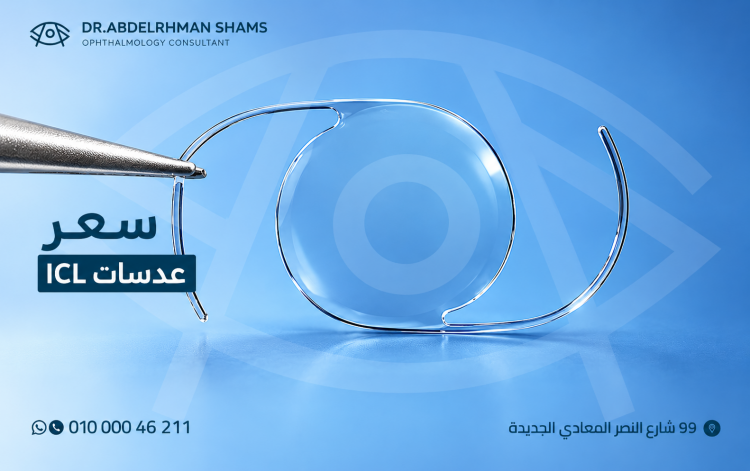
ICL lens implantation is the ideal and lifesaving medical solution for people with severe myopia or corneal thinning that prevents them from undergoing traditional LASIK surgery. If you have decided to eliminate your corrective eyewear through this phakic intraocular lens technique, understanding the total ICL surgery cost and evaluating this long-term investment in your optical health is essential.
In this article, we detail all clinical and pharmacological factors determining the ICL lens price in Egypt, offering a transparent breakdown of the procedure's financial value. (If you are looking for details about surgical indications, pre-operative criteria, and potential contraindications, refer to our comprehensive clinical guide on the procedure).
Ophthalmic Consultation: How Much Is the ICL Surgery Cost
At Dr.abdelrhman shams surgical center, the ICL starts from 30,000 Egyptian pounds per eye.
This figure remains highly competitive given the specialized surgical care provided. The biocompatible collamer lens is placed safely in the posterior chamber behind the iris, delivering permanent high-definition (HD) vision with the clinical benefit of reversibility without disrupting the structural integrity of corneal tissue.
Surgical Protocol Breakdown: What Does the ICL Surgery Cost Include?

Clinical transparency is central to the physician-patient relationship. Assessing the ICL surgery cost involves more than the implant itself; it covers a comprehensive microsurgical framework designed for maximum safety:
- Authentic Collamer Implants: Utilizing genuine, biocompatible EVO Visian ICL lenses with zero tissue rejection.
- Aseptic Operating Theatres: Operations are conducted in ultra-sterile environments compliant with international infection control protocols.
- Single-Use Surgical Consumables: Sterile ophthalmic viscoelastic devices (OVD), disposable microsurgical knives, and topical anesthetics used exclusively per patient.
- Postoperative Intraocular Surveillance: Monitoring intraocular pressure (IOP) and vault clearance during the critical early recovery phase.
Biomechanical & Anatomical Variables Influencing the ICL Surgery Cost

Because ocular anatomy varies significantly, there is no fixed rate across all patients. Several diagnostic and anatomical factors dictate the overall ICL surgery cost:
- Spherical vs. Toric ICL Variants: Standard spherical designs correcting only myopia involve a lower production cost. In contrast, Toric ICL models—tailored for combined severe myopia and corneal astigmatism—require complex rotational axis calibration, directly influencing the ICL surgery cost.
- Manufacturer Origin & Biomaterial Standards: FDA-approved lenses engineered from purified porcine collagen copolymers offer advanced biocompatibility and central port flow (Aquaport) to prevent secondary cataracts and pupillary block.
- Anterior Segment Tomography: High-precision anterior segment OCT, ultrasound biomicroscopy (UBM), and Pentacam corneal scans are essential to calculate anterior chamber depth (ACD) and white-to-white (WTW) diameter before ordering custom implants.
- Microsurgical Expertise: The operating surgeon’s training in phakic intraocular implantation directly influences surgical fees.
Refractive Comparative Analysis: Corneal Ablation (LASIK) vs. Intraocular Implantation
Patients frequently compare corneal refractive surgery with phakic lens implantation to assess overall value and clinical efficacy:.
Patients frequently compare corneal refractive surgery with phakic lens implantation to assess overall value and clinical efficacy. In this context, medical guidelines from the Mayo Clinic highlight phakic intraocular lenses (ICL) as a highly effective and safe alternative for individuals who are not ideal candidates for traditional LASIK.
Their reports confirm that these implants deliver excellent high-definition visual outcomes while completely preserving the natural corneal architecture, making them an optimal,
long-term choice for patients with severe myopia or thin corneas.
|
Clinical Comparison Parameter |
Corneal Laser Ablation (LASIK) |
Phakic Intraocular Implantation (ICL) |
|
Mechanism of Correction |
Laser ablation of corneal stroma |
Posterior chamber placement of a custom collamer lens |
|
Overall Expenditure |
Low to moderate initial expense |
Higher initial ICL surgery cost due to custom fabrication |
|
Corneal Thickness Limitations |
Requires adequate residual bed (>250-300 μm) |
Preserves original corneal architecture completely |
|
Ocular Surface Complications |
Elevated incidence of post-refractive dry eye |
Zero ablation; negligible risk of permanent dry eye syndrome |
|
Procedural Reversibility |
Irreversible structural modification |
100% reversible; lens can be explanted or exchanged safely |
Long-Term Pharmacological & Optical Economics: Is the ICL Surgery Cost Justified?
While the initial ICL surgery represents a capital medical procedure, it acts as a permanent corrective solution. When contrasted with the recurring costs of custom high-index prescription lenses, specialized contact lenses, sterile disinfection regimens, and ongoing management of lens-induced surface toxicity over a 10-year span, the one-time procedure provides superior long-term financial efficiency and visual stability.

Consultant-Led Microsurgery: Dr.abdelrhman shams
Intraocular refractive surgery requires exceptional surgical precision to avoid endothelial compromise or incorrect vault sizing. Choosing an accredited refractive surgeon ensures optimal visual outcomes:
- Lecturer of Ophthalmology, Ain Shams University (Doctorate in Ophthalmology).
- Fellow of the International Council of Ophthalmology (FICO, England).
- Member of the Royal College of Surgeons of Edinburgh (MRCS Ed).
- Founder and Director of the Ocular Surface and Dry Eye Unit, Maadi Specialized Eye Center.
In this context, medical reviews published by WebMD highlight that Implantable Collamer Lenses (ICL) serve as a highly effective and safe alternative for individuals who are not ideal candidates for traditional LASIK, particularly those with severe myopia or thin corneas. The global health authority emphasizes that unlike laser ablation which permanently removes corneal tissue, the ICL procedure completely preserves the eye's natural structural integrity while delivering superior, high-definition visual acuity. (Tip: Keep "WebMD" or "Implantable Collamer Lenses (ICL)" as the anchor text for the hyperlink).
Clinical Case Review: Patient Outcome Post-ICL Implantation
Diagnosed with extreme axial myopia and sub-threshold corneal thickness, LASIK was contraindicated. Dr.abdelrhman shams recommended posterior chamber phakic implantation. After discussing the ICL surgery cost and procedural steps, I proceeded with confidence. The microsurgery took 15 minutes per eye under topical anesthesia. Vault placement was exact, and my postoperative visual acuity reached 20/15 without visual aberrations."
الاسئله الشائعة
Refractive procedures are generally categorized as elective optical interventions under commercial health plans. However, coverage may apply if standard glasses or contacts fail to correct high anisometropia or irregular refractive errors. We recommend contacting our administration to review specific diagnostic documentation required by medical underwriters.
Yes. Collamer exhibits complete immunological inertness and remains functional indefinitely within the posterior chamber without opacification or biological degradation. Should cataract development occur decades later, the implant can be explanted through the primary incision without anatomical complications.
احدث المقالات
PRK Eye Surgery | Safely Ditch Your Glasses
2026-09-20


Custom Femto LASIK for Perfect Vision
2026-09-15